 Mar
09
Mar
09
Business Continuity and Disaster Recovery Services: Building Resilient Cloud Operations
Organizations today rely heavily on digital systems, cloud platforms, and interconnected applications to deliver services and manage operations. However, unexpected disruptions—such as cyberattacks, infrastructure failures, natural disasters, or system outages—can significantly impact business performance and customer trust.
To reduce these risks, companies implement business continuity and disaster recovery services (BCDR) that ensure operations continue during disruptions and systems recover quickly afterward. These services combine strategic planning, cloud technologies, and automated recovery processes to safeguard data, applications, and infrastructure.
As enterprises increasingly operate in hybrid and multi-cloud environments, BCDR services have become essential for maintaining operational resilience and protecting critical business assets.
Your business deserves a tailored financial strategy.
Start with a Free Consultation – https://www.ibntech.com/free-consultation-for-cloud/
What Are Business Continuity and Disaster Recovery Services?
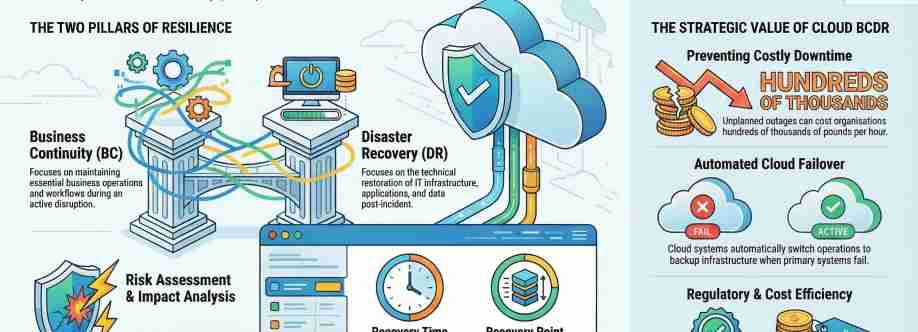
Business continuity and disaster recovery services refer to a set of technologies, policies, and procedures designed to help organizations continue operating and restore systems after unexpected disruptions. These strategies identify potential risks, protect critical data, and enable businesses to resume operations as quickly as possible.
Although closely related, business continuity and disaster recovery address different aspects of resilience:
• Business Continuity (BC): Focuses on maintaining essential business operations during a disruption.
• Disaster Recovery (DR): Focuses on restoring IT infrastructure, applications, and data after an incident.
Together, these strategies create a comprehensive framework that helps organizations manage crises effectively while minimizing operational and financial impact.
Key Components of Business Continuity and Disaster Recovery Services
Effective BCDR services integrate multiple processes and technologies that strengthen organizational resilience.
Risk Assessment and Business Impact Analysis
The first step in a BCDR strategy is identifying potential risks that could disrupt operations. Organizations evaluate threats such as cyberattacks, power outages, natural disasters, and infrastructure failures.
A business impact analysis (BIA) then determines how these disruptions would affect critical operations, allowing companies to prioritize systems and processes for recovery.
Business Continuity Planning
Business continuity planning focuses on maintaining operational workflows during disruptions. This includes developing procedures for employee communication, customer service continuity, and operational coordination during emergencies.
Well-designed continuity plans ensure organizations can continue delivering products or services even when major systems are temporarily unavailable.
Disaster Recovery Planning
Disaster recovery planning focuses specifically on restoring IT systems and data. It outlines recovery procedures, backup systems, and failover infrastructure that allow organizations to restore operations after outages or cyber incidents.
A disaster recovery plan typically defines key recovery metrics such as:
• Recovery Time Objective (RTO): Maximum acceptable downtime before services must be restored.
• Recovery Point Objective (RPO): Maximum acceptable amount of data loss during a disruption.
These metrics help businesses determine how quickly systems must recover to minimize operational impact.
Backup, Replication, and Failover Systems
Modern BCDR services rely heavily on cloud technologies for data protection. Cloud backup systems store copies of critical data across multiple geographic locations.
Replication technologies continuously synchronize data between environments, enabling failover systems that automatically switch operations to backup infrastructure when primary systems fail.
Testing and Continuous Improvement
BCDR plans must be tested regularly to ensure they function effectively during real incidents. Organizations conduct simulation exercises, disaster recovery drills, and system testing to identify vulnerabilities and improve response procedures.
Why Businesses Need BCDR Services in the Cloud Era
As organizations become increasingly dependent on digital infrastructure, downtime and data loss can have severe financial consequences. Studies indicate that unplanned outages can cost organizations hundreds of thousands of dollars per hour, highlighting the importance of robust recovery strategies.
Cloud-based BCDR solutions help organizations address these challenges by providing scalable infrastructure, automated recovery processes, and geographically distributed data centers.
These capabilities allow businesses to maintain service availability even when primary infrastructure experiences failures.
Benefits of Business Continuity and Disaster Recovery Services
Implementing BCDR services provides organizations with several operational and strategic benefits:
Minimized downtime: Rapid recovery systems restore applications and services quickly.
Enhanced data protection: Backup and replication technologies safeguard critical data.
Improved operational resilience: Organizations can continue delivering services even during disruptions.
Regulatory compliance: Many industries require documented continuity and recovery plans.
Cost efficiency: Cloud-based recovery solutions reduce the need for expensive secondary infrastructure.
These advantages help organizations maintain productivity, protect revenue streams, and strengthen stakeholder confidence.
The Role of Cloud Technology in BCDR
Cloud computing has transformed how organizations implement business continuity and disaster recovery strategies. Traditional recovery models required duplicate data centers and expensive infrastructure investments.
Cloud-based BCDR solutions provide flexible, scalable environments where data and applications can be replicated across multiple regions. This distributed architecture improves system availability and allows organizations to restore operations quickly during disruptions.
Cloud platforms also support automation, monitoring, and analytics tools that enable faster detection of system failures and quicker recovery responses.
The Future of Business Continuity and Disaster Recovery Services
As digital transformation continues to accelerate, BCDR services are evolving alongside emerging technologies such as artificial intelligence, automation, and predictive analytics.
AI-powered monitoring tools can detect anomalies in infrastructure performance and predict potential failures before they occur. Automated recovery systems can trigger failover processes instantly, significantly reducing downtime.
Additionally, hybrid and multi-cloud architectures are shaping the next generation of BCDR solutions, enabling organizations to protect workloads across multiple platforms while maintaining centralized management and visibility.
Organizations that invest in advanced business continuity and disaster recovery services will be better equipped to handle unexpected disruptions, protect critical assets, and maintain operational stability in an increasingly digital world.
Related Services:
https://www.ibntech.com/devsecops-services/
About IBN Technologies
IBN Technologies LLC is a global outsourcing and technology partner with over 26 years of experience, serving clients across the United States, United Kingdom, Middle East, and India. With a strong focus on Cybersecurity and Cloud Services, IBN Tech empowers organizations to secure, scale, and modernize their digital infrastructure. Its cloud portfolio includes multi-cloud consulting and migration, managed cloud and security services, business continuity and disaster recovery, and DevSecOps implementation—enabling seamless digital transformation and operational resilience.
Complementing its technology-driven offerings, IBN Technologies delivers Finance & Accounting services such as bookkeeping, tax return preparation, payroll, and AP/AR management. These services are enhanced with intelligent automation solutions including AP/AR automation, RPA, and workflow automation to support accuracy, compliance, and operational efficiency. Its BPO services support industries such as construction, real estate, and retail with specialized offerings including construction documentation, middle and back-office support, and data entry services.
Certified with ISO 9001:2015 | 20000-1:2018 | 27001:2022, IBN Technologies is a trusted partner for businesses seeking secure, scalable, and future-ready solutions.


